Collagen is everywhere in beauty right now: powders, masks, creams, and pedicures. We offer a Collagen Seasonal Pedicure, and our guests love it. But we believe you deserve the real science behind it, not just the buzzword. So here's an honest breakdown of what topical collagen can and can't do, what the research says truly helps cracked heels, and how to keep your feet soft through a Maryland winter.
Why heels crack in the first place
The skin on the soles of your feet is built differently from the rest of your body:
- It has no oil glands. Palms and soles have no sebaceous glands, so they depend entirely on sweat and outside moisture to stay supple.
- It's the thickest skin you have. The outer layer (stratum corneum) on the heel is thick and rigid. When it dries out, it loses flexibility.
- It takes your full body weight. With every step, the heel pad spreads outward. Dry, rigid skin can't stretch, so it splits, creating fissures that can become painful or even bleed.
Maryland's climate makes it worse. Our humid summers encourage sandals and open-back shoes, which let the heel pad expand without support. Then, in winter, indoor heating drives humidity down. The EPA recommends keeping indoor humidity roughly between 30% and 50%, and heated homes in cold months often fall below that range.
Some medical conditions, including diabetes, thyroid disease, psoriasis, eczema, and athlete's foot, can also cause or worsen cracked heels. If your cracks are deep, bleeding, or not improving, see a healthcare provider.
What topical collagen can and can't do
Here's the part most marketing skips. Your skin is an excellent barrier. A classic dermatology principle known as the "500 Dalton rule" (Bos and Meinardi, Experimental Dermatology, 2000) observes that molecules larger than about 500 daltons penetrate skin poorly. Native collagen molecules are around 300,000 daltons, hundreds of times too large to soak into the skin and "replace" your own collagen. Hydrolyzed collagen fragments are smaller but still mostly stay on the surface.
That doesn't make collagen useless. On the surface, collagen acts as a humectant and film-former: it attracts water and forms a light, smoothing layer that helps skin hold moisture and feel softer. Paired with exfoliation, warm water, and massage, that makes for a genuinely hydrating treatment.
What the research supports for cracked heels
| Ingredient or step | What it does | How to use it |
|---|---|---|
| Urea (10–25%) | Humectant that also loosens thick, hardened skin | Nightly on heels; higher strengths for thick calluses |
| Lactic acid / ammonium lactate | Gentle exfoliant and humectant | Nightly or every other night |
| Salicylic acid | Softens and breaks down thick skin | Short-term for stubborn buildup |
| Occlusives (petrolatum, shea butter) | Seal water in and reduce evaporation | Last layer at night, cotton socks on top |
| Professional exfoliation | Safely reduces callus thickness | Every 3–4 weeks |
| Supportive, closed-back shoes | Keeps the heel pad from spreading | Daily, especially in winter |
The American Academy of Dermatology recommends a similar approach: soak briefly, gently exfoliate, apply a thick moisturizer, and seal it in.
What about collagen supplements?
Oral collagen peptides are a different story from creams, because they're digested into small fragments. A 2021 meta-analysis in the International Journal of Dermatology (19 studies, 1,125 participants) found improvements in skin hydration and elasticity. However, researchers have cautioned that many of these trials were funded by supplement makers, and benefits appear smaller in independent, higher-quality studies. If you're curious, talk with your doctor, and don't expect supplements to replace good foot care.
Inside our Collagen Seasonal Pedicure
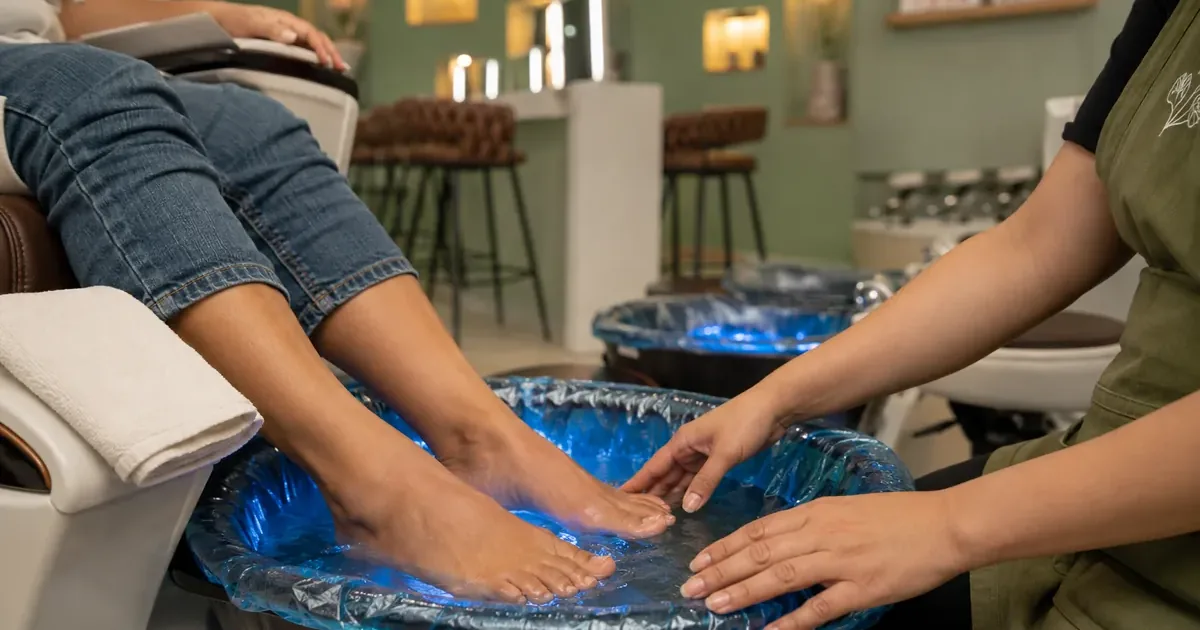
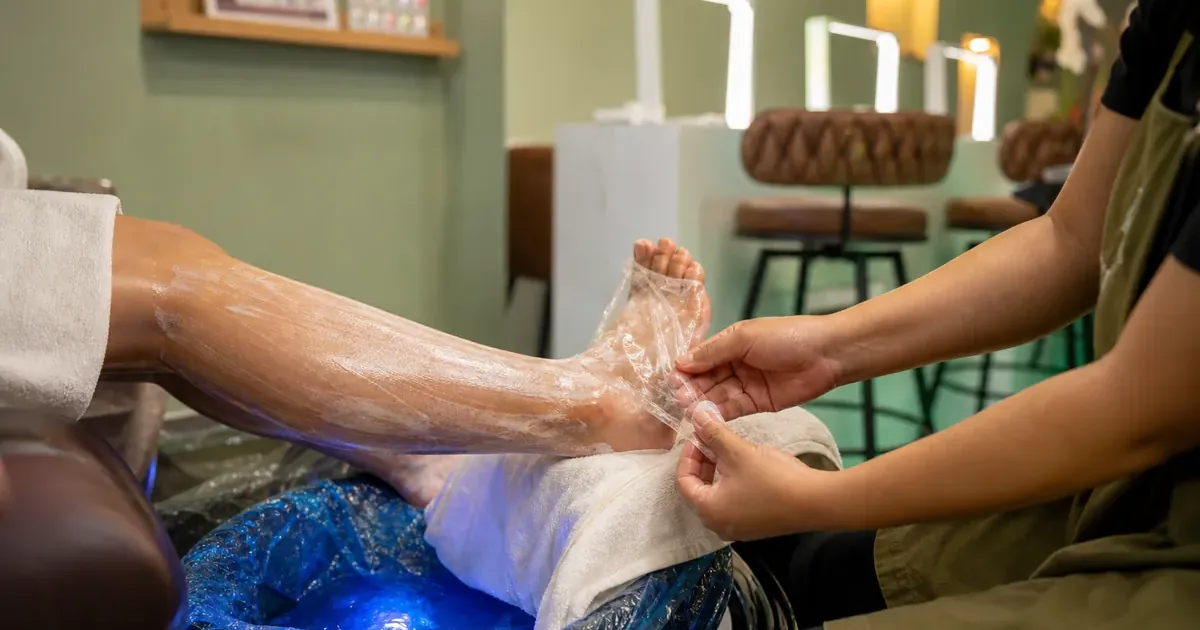
Our Collagen Seasonal Pedicure is designed around what the evidence supports. It includes a warm soak, gentle exfoliation, careful callus smoothing (never with a blade), a collagen mask to hydrate and soften, a relaxing massage, and a rich moisturizer to seal it all in. The "seasonal" part means we refresh scents and textures with the time of year, so autumn and winter feel cozy while spring and summer feel light.
Because results build over time, collagen pedicures are part of our Package: Buy More, Get More Free program (buy 5, get 1; buy 8, get 2; buy 11, get 3). Check our specials page for current weekday offers.
Your at-home routine between visits
- After your evening shower, pat feet dry and apply a urea or lactic acid cream to the heels.
- Seal with an occlusive balm and slip on cotton socks.
- Gently file heels once or twice a week while dry, never shaving or cutting skin.
- Swap open-back shoes for supportive ones in winter.
- Run a humidifier if your home feels very dry.
Visit us for softer heels in Hyattsville
LaVina Nail & Spa is at 7990 New Hampshire Ave, Hyattsville, MD 20783, near Takoma Park, Silver Spring, Langley Park, Adelphi, and College Park. Open Monday–Saturday 10 AM–8 PM, Sunday 11 AM–6 PM. Call (301) 234-5000 or see our pedicure menu.
Frequently Asked Questions
Does a collagen pedicure actually work?
It works as a hydrating, softening treatment. Collagen molecules are too large to penetrate the skin and rebuild collagen, but on the surface they attract moisture and form a smoothing film, especially when paired with exfoliation and a rich moisturizer.
What is the fastest way to heal cracked heels?
For most people, the fastest results come from nightly urea or lactic acid cream sealed with an occlusive balm and cotton socks, gentle filing, and supportive shoes. Deep, painful, or bleeding cracks should be checked by a healthcare provider.
How often should I get a pedicure for dry feet?
Every three to four weeks works well for most people, combined with a simple nightly routine at home. In winter, when indoor air is drier, some guests prefer every three weeks.
Why are my heels worse in winter?
Indoor heating lowers humidity, which pulls moisture from skin. Because the soles of your feet have no oil glands, they lose moisture quickly and become rigid, making cracks more likely.
References
- Bos JD, Meinardi MM. The 500 Dalton rule for the skin penetration of chemical compounds and drugs. Exp Dermatol. 2000;9(3):165–169.
- de Miranda RB, Weimer P, Rossi RC. Effects of hydrolyzed collagen supplementation on skin aging: a systematic review and meta-analysis. Int J Dermatol. 2021;60(12):1449–1461.
- American Academy of Dermatology. How to treat cracked heels. aad.org.
- U.S. Environmental Protection Agency. Care for Your Air: A Guide to Indoor Air Quality (recommended indoor humidity). epa.gov.