
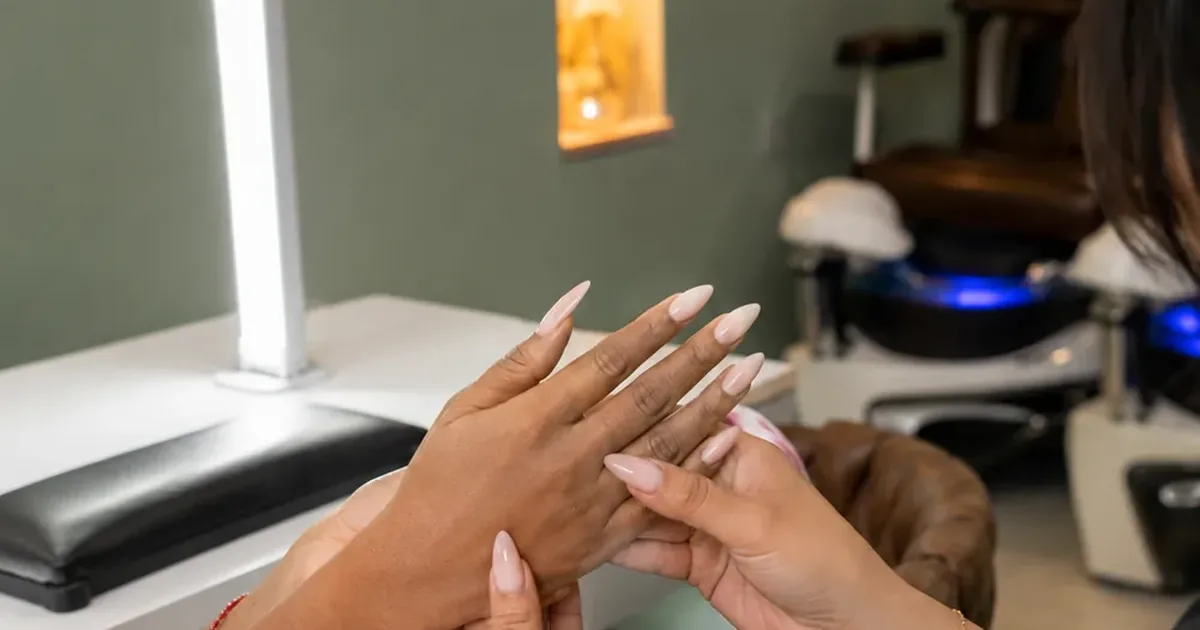
Here is something most people never hear at the nail salon: the biggest risk to your natural nails usually isn't wearing extensions. It's how they come off. Peeling, prying, and heavy drilling remove layers of your own nail plate along with the product. Understanding that one fact changes how you choose an extension system and where you get it done.
This guide explains, in plain language, what Gel-X is, how it compares with acrylic and hard gel, and what the dermatology research says about keeping your natural nails healthy underneath.
First, a 60-second anatomy lesson
Your fingernail plate is made of tightly packed layers of hardened keratin, the same family of protein found in hair. In adults, it is typically only about half a millimeter thick. Healthy nail plates hold a small amount of water (around 18% is often cited), which is what keeps them flexible instead of brittle.
Growth is slow. A study of healthy young American adults published in the Journal of the European Academy of Dermatology and Venereology measured average fingernail growth at about 3.47 mm per month and toenail growth at about 1.62 mm per month. In practical terms, a fingernail you damage today takes roughly four to six months to grow out completely. That timeline is why prevention matters so much more than repair.
What exactly is Gel-X?
Gel-X is a soft-gel extension system created by Aprés Nail. Instead of sculpting a nail from liquid and powder (acrylic) or building layers of thick gel, your technician selects pre-shaped, full-coverage soft-gel tips that match the width of each natural nail. The tip is bonded with a gel adhesive and cured under an LED lamp.
Three features make it different:
- Less aggressive prep. The natural nail surface is lightly buffed to remove shine rather than filed down heavily.
- Full-coverage tips. Because the tip covers the entire nail, there's no visible seam to blend with a drill.
- Soak-off removal. Soft gel breaks down in acetone, so it can be removed by soaking rather than by grinding or prying.
Gel-X vs. acrylic vs. hard gel vs. press-ons
| Feature | Gel-X (soft gel) | Acrylic | Hard gel / builder | Press-ons |
|---|---|---|---|---|
| How it's built | Pre-shaped soft-gel tip + gel adhesive | Liquid monomer + powder, sculpted | Thick gel layered and cured | Pre-made tip + glue or tabs |
| Surface prep | Light buff | Moderate to heavy filing | Moderate filing | Light buff |
| Removal | Acetone soak-off | Long soak or filing | Mostly filed off | Soak or lift |
| Typical wear | About 3–4 weeks | 2–3 weeks between fills | 3–4 weeks with infills | Days to 2 weeks |
| Feel | Lightweight, flexible | Rigid, very strong | Strong, slightly flexible | Varies |
None of these is automatically "bad." Acrylic is excellent for very long, dramatic shapes; builder gel is great for strengthening short natural nails. Gel-X tends to suit people who want length and a natural look with minimal filing.
Where nail damage really comes from
Dermatologists consistently point to three culprits:
- Peeling or picking off gel. The American Academy of Dermatology advises against peeling off gel polish because it pulls away the top layers of the nail plate. The rough, white, flaky patches you sometimes see after removal are called keratin granulations: superficial keratin damage that signals the surface has been disrupted.
- Over-filing. Every pass of a coarse file or drill bit removes nail plate. A half-millimeter plate doesn't have much to spare.
- Wearing a set too long. Your nail grows about 3 mm a month. After four or more weeks, the extension's weight sits farther out on the free edge, which increases leverage, lifting, and the chance of a painful break.
The removal protocol that protects your nails
A safe Gel-X removal takes a little patience. Here is the process we follow:
- Lightly file only the shiny top coat so acetone can penetrate.
- Wrap each nail in acetone for roughly 10–15 minutes.
- Gently slide away softened product with a wooden or rubber-tipped pusher. If it doesn't release easily, it goes back to soak. We never pry.
- Finish with a light buff and cuticle oil to replace lipids the acetone removed.
Acetone does temporarily dry the nail and surrounding skin, but that dehydration is reversible with oil and moisturizer. Mechanical damage from prying is not.
Who should wait before getting extensions
Skip extensions until you've seen a clinician if you have signs of a fungal infection (thickened, yellowed, or crumbling nails), broken or infected skin around the nail, or a history of allergic reactions to gel products (itchy, swollen fingertips or lifting nails after a service). Acrylate allergy is real and permanent once developed, which we cover in our guide to clean gel ingredients.
Gel-X at LaVina Nail & Spa
At LaVina, physical well-being comes first. That means light prep, careful sizing so tips don't flood the cuticle, LED curing, and soak-off removal every single time. If you want a natural-looking set, our technicians will help you choose a length and shape that fit how you actually use your hands, whether you type all day, work in healthcare, or lift weights.
Want something truly one-of-a-kind on top of your set? Pair Gel-X with custom design through Nail Muse, our personalized nail design service. You can find current extension pricing on our services page, and check our specials page for weekday Gel-X offers.
Visiting us in Hyattsville
LaVina Nail & Spa is at 7990 New Hampshire Ave, Hyattsville, MD 20783, a short drive for guests coming from Takoma Park, Silver Spring, Adelphi, College Park, and Langley Park. We're open Monday and Wednesday through Saturday, 10 AM–8 PM, and Sunday, 11 AM–6 PM (closed Tuesday). Call (301) 234-5000 or book online.
Frequently Asked Questions
Is Gel-X better for your natural nails than acrylic?
Gel-X typically requires less filing and comes off with an acetone soak, which reduces mechanical damage. But any system can harm nails if it's applied with heavy filing or removed by prying. Technique matters more than brand.
How long does a Gel-X set last?
Most guests wear Gel-X for about three to four weeks. Because fingernails grow roughly 3.5 mm per month, we recommend removal or replacement by week four to avoid lifting and breakage.
Can I remove Gel-X at home?
You can, if you file off the top coat and soak with acetone patiently. Never peel or pry the tips off, because that removes layers of your natural nail. When in doubt, book a professional removal.
Does Gel-X use UV light?
Gel-X is cured under an LED lamp. LED nail lamps still emit ultraviolet-A light, just in a narrower band and for shorter cure times. See our guide to UV nail lamp safety for simple ways to limit exposure.
References
- Yaemsiri S, Hou N, Slining MM, He K. Growth rate of human fingernails and toenails in healthy American young adults. J Eur Acad Dermatol Venereol. 2010;24(4):420–423.
- American Academy of Dermatology. How to remove gel nail polish safely / Nail care tips. aad.org.
- Baran R, de Berker D, Holzberg M, Thomas L (eds). Baran and Dawber's Diseases of the Nails and Their Management. Wiley-Blackwell (nail plate structure and keratin granulations).
- Aprés Nail. Gel-X system product and removal information. apresnail.com.